Category: Uncategorized

  • Motorcycles, Motonormativity and Two Motormouths

    Motorcycles, Motonormativity and Two Motormouths

    Or, what former Top Gear presenters can tell us about road safety

    “Wales’s 20mph speed limit has cut road deaths. Why is there still even a debate?” – Peter Walker

    About a million years ago I rode a motorcycle on the road for the very first time.

    It. Was. Brilliant!

    I was travelling at the heady speed of 20mph and it felt like I was breaking all kinds of land speed records.

    In actual fact I was going so slowly the instructor had to tell me to speed up!

    And this is why, if I ruled the universe, everyone who wanted to learn to drive a car – and was able to do so – would first have to pass their motorcycle CBT.

    Unless you’ve felt the force of the wind against your head and chest you have no real idea what speed is.

    In the car bubble you are so cocooned from reality and distracted by the television that being expected to watch your speed becomes a major inconvenience.

    But could it be that there are some benefits to driving slower?

    Well, some of the results are in…

    Keep reading on Substack!

    #jeremyclarkson #jamesmay #cars #20mph #nationaldesignguide #transport #newtowns #motonormativity #designcodes

  • A Bill, Some Insanity and a Conspiracy

    A Bill, Some Insanity and a Conspiracy

    Or, how a lack of control over some highways authorities will crash the government’s new towns aspirations

    “It is staggering how much damage transportation planning did to cities in the short period of the life of the car.” – David Burney

    Why oh why are highways authorities permitted to continue using outdated guidance when we know that doing so puts vulnerable road users at unnecessary – and potentially fatal – risk?

    Find out on Substack…

    #placemaking #janejacobs #jangehl #manualforstreets #urbandesigngroup #udg #LTN1/20 #nationaldesignguide #nationalmodeldesigncode #gearchange #NPPF

  • The King, A Vision and a Thoroughbred’s Arse

    The King, A Vision and a Thoroughbred’s Arse

    Where once we were creating a thoroughbred of a scheme that people would have travelled from all over the world to marvel at, all we’re going to be left with now is its arse – The Urban Sketch Writer

    Let’s step off the merry-go-round of global politics for a moment, give thanks that the US is now supporting Ukraine once again and distract ourselves with the news that Transport for New Homes are back with their latest report: What is being built in 2025? In search of the station…

    Perhaps not the snappiest title but it represents the fourth piece of research from TfNH that concludes – once again – that for the most part we are building homes in the wrong places.

    To regular readers of this newsletter this will come as no surprise.

    It’s a common theme.

    Perusing the contents, what we seem to be really good at delivering here in the UK are…

    Find out the answer on Substack!

    #publictransport #bus #walking #cycling #transportfornewhomes #sustainable #sustainabletransport #poundbury #homes #newtowns #masterplanning

  • LTNs, Andouillette Sausages, a Special Invitation and an Apology

    LTNs, Andouillette Sausages, a Special Invitation and an Apology

    Or, what a French gastronomic delicacy has to do with life and death

    “People living in LTNs talk about hearing more birds, a stronger sense of community, and the pleasure of seeing young people on bicycles on roads which are much safer.” – Laura Laker

    The subject of LTNs – like Trump’s re-election, Brexit, HS2*, or being sat at a table where someone goes ahead and orders that pungent French Andouillette sausage that’s made of tripe – can literally split a room and ruin a pleasant evening with friends…

    Keep reading on Substack!

    #placemaking #20mph #jangehl #tomflood #LTN #lowtrafficneighbourhoods #streetexperiments #waronthemotorist

  • Good News, New Towns and a Vision!

    Good News, New Towns and a Vision!

    Or, how a sweary creative writer is influencing the new town discussion…

    Find out more on Substack >>>

    #groningen #activetravel #bus #publictransport #newtowns #urbandesign #janejacobs

  • Eyeballs, CEOs and Cold Rice

    Eyeballs, CEOs and Cold Rice

    What the Mirror can teach us about life as a built environment professional

    This week: Eyeballs, CEOs and Cold Rice – or, what the Mirror can teach us about life as a built environment professional.

    The thing I love about writing on this blog or on Substack is that I’m not likely to be kicked off it anytime soon. Whether one person reads this or 10,000 is irrelevant. However, things aren’t so peachy everywhere. A piece in the latest Private Eye (1642) tells us that hacks at the Mirror are now expected to “… hit personal targets for how many views their stories receive on the paper’s website each month…” regardless of the topic.

    For some reason this edict has failed to boost morale. A union rep who sent a letter representing concerned editorial staff to the editor was immediately placed on gardening leave and all traces of her existence were removed from the office. Thankfully she was already working her notice period and due to leave for pastures new in a few weeks anyway. Some might call an earlier than planned exit merciful under the circumstances.

    But even so.

    How on earth are we supposed to know what combination of words is going to get our stories read?

    And is getting a minimum number of eyeballs on our work actually the least of our worries?

    In case you’re wondering what bad management practices at mainstream newspapers has got to do with the built environment, a recent article in Dezeen has shared the results of a working conditions survey into the architecture and design industry. While not a completely scientific investigation…

    Keep reading on Substack!

    #transportfornewhomes #placealliance #BBBBC #RTPI #urbandesign #refuseugliness

  • Misogyny, mobile phones and an ASDA car park

    Misogyny, mobile phones and an ASDA car park

    Some Simple Chat Show Truths for the Built Environment

    When I first started commenting on the built environment last autumn, it was an appearance by Saoirse Ronan on the Graham Norton Show that started it all.

    Did you see that episode?

    And what did you think?

    After all, it was the evening television stopped – albeit for a brief, ulcer-inducing moment.

    Saoirse had to prompt the host and fellow guests – all men – to basically STFU on the topic of women’s safety as they collectively rolled around giggling at the seeming absurdity of a woman resorting to using a mobile phone as a means of defending herself.

    Let’s face it, asking someone politely to stop assaulting you in public – *checks notes* – doesn’t work. We have yet to reach that level of civility, let alone a level of civility in which such attacks would simply never occur.

    Eventually the lads did graciously allow Saoirse a chance to get a word in and their reaction provided the GNS with a moment of ‘dead air’ sufficient to get you sacked as a DJ on Radio 2…

    … Like this post? Keep reading on Substack!

  • Playgrounds, California, Manual for Streets… and Shared Space?

    Playgrounds, California, Manual for Streets… and Shared Space?

    Folks, it’s here, it’s here! My new project is now up and running!

    Enjoy reading over on my Substack page!

    #manualforstreets #sharedspace #urbandesign #kensingtonhighstreet #ashfordringroadproject #exhibitionroad #poynton #fountainplace #theurbansketchwriter

  • Cool streets, Trump and Walkability

    Cool streets, Trump and Walkability

    [This content first appeared on LinkedIn on 22 January 2025]

    In the news this week: Cool streets! Trump! Walkability! 

    What a difference a Monday in January makes. While President Trump has just withdrawn the US from the Paris Climate accord and intends to “drill, baby, drill”, there is still good news for environmentalists and those with a general interest in the ongoing survival of the human project from elsewhere in the world. 

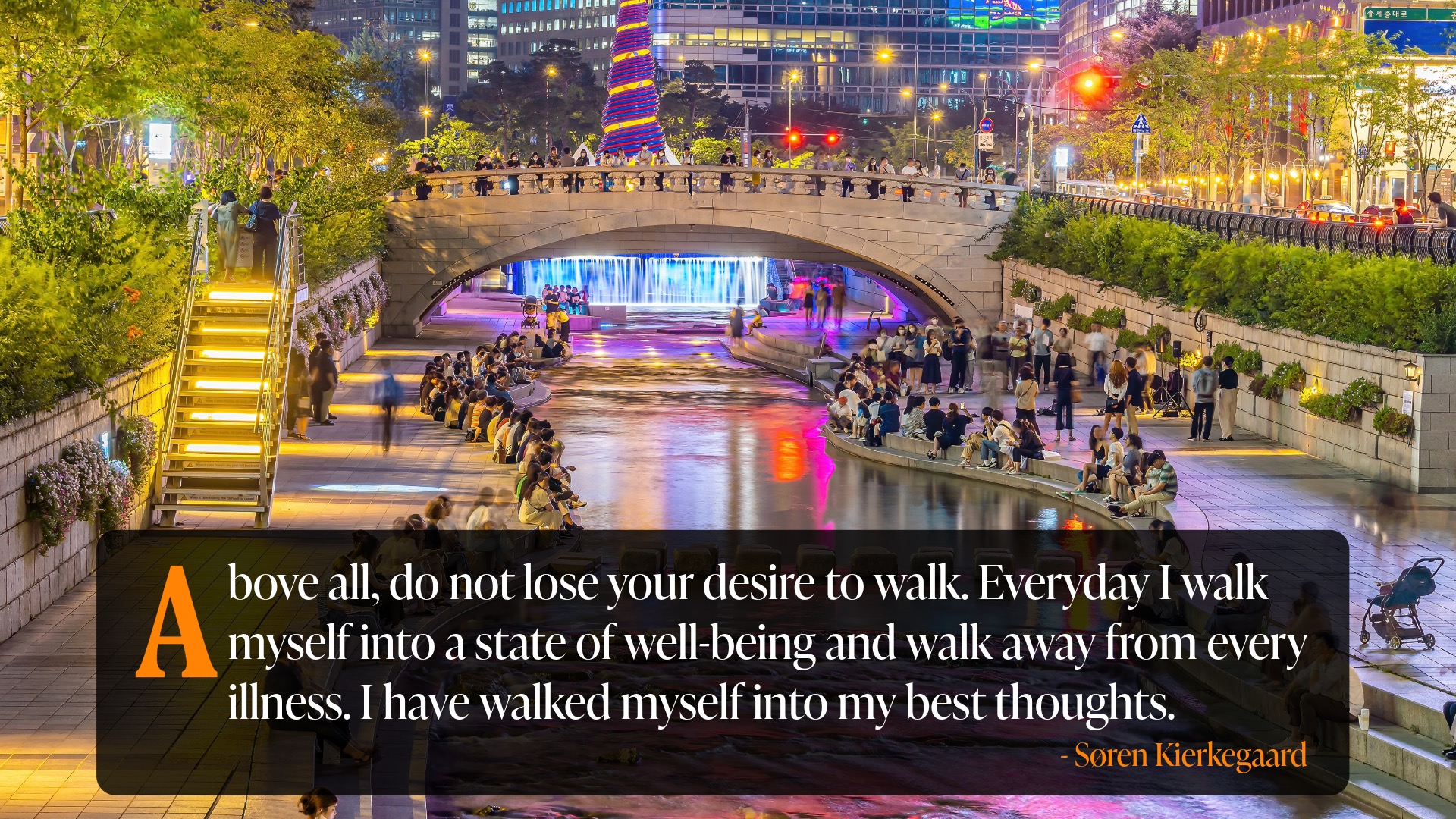
    In Seoul, the Cheonggyecheon stream has been successfully released from its concrete prison beneath an elevated highway and turned into a highly loved and popular space for pedestrians and cyclists.

    While we aren’t likely to see anything like this occurring in the US anytime soon, the Cheonggyecheon project was one of the first to start a trend of cities turning car dominated spaces into oases for walkers and wheelers. See also New York’s High Line, Utrecht’s city moat and the Paris Plages on the banks of the Seine.

    As Jan Gehl has always said: you get what you invite. And these projects are certainly doing much to invite people on foot or bike back into the city centres.

    In addition, the Seoul Institute has reported that the area around the stream is now 3.6oc cooler than surrounding streets and nitrogen dioxide levels have fallen by 35%. The stream supports 174 animal species and 492 plant species. Further, the Cheonggyecheon has been designed to handle 200-year flood events.

    As Cheonggyecheon is seasonal, it unsurprisingly costs quite a bit of cheddar to keep it wet year-round. But the benefits to the environment, residents and visitors can’t be underestimated. You get what you invite.

    So, let’s stick with the walkability theme for a moment. 

    In what feels like 27 years ago, ARUP published their ‘Cities Alive – Towards a walking world’ report. At the time, the report was picked up by Fast Company, who published a handy synopsis of the ’50 Reasons Why Everyone Should Want More Walkable Streets’ on their website in 2016.

    My angle is street safety and the urbanism of Jane Jacobs – if people feel safe in a place, they’ll use it. Not all walkable environments achieve this, so let’s take a quick run through some of the benefits on offer if you can get it right:

    • Eyes on the street – which I’ve commented on before…
    • Crime reduction – e.g. 74% drop in one Kansas City neighbourhood when some streets went car-free on weekends…
    • Universally accessible – not everyone can or wants to drive, enabling everyone to visit can only be good for diversity and safety
    • Social interaction – trivial interaction with strangers creates a web of trust…
    • Public transit – a pleasant, safe walk to the transit stop will… wait for it… encourage people to use public transport

    These things are not complicated. This is Urban Design 101 for placemakers. We get what we invite.

    #placemaking #cheonggyecheon #walkability #janejacobs #jangehl #ARUP #urbanism
  • New towns, Barbara Cartland and public transport

    New towns, Barbara Cartland and public transport

    [This content first appeared on LinkedIn on 15 January 2025]

    This week: New Towns, Barbara Cartland and public transport!

    Create Streets are in the news this week with the publication of their discussion paper ‘Creating New Towns Fast And Well’.

    After all, the 1.5 million new homes planned over the next parliament are going to have to go somewhere… and hopefully not in random fields in the middle of nowhere with a grand view of a motorway flyover.

    The seven Design Principles set out in the paper are all solid urban design approaches and don’t say anything new, except that maybe these principles cannot be stated too often given the below par development that still keeps getting approved.

    But the thing that really stood out for me was the lack of promotion of public transport.

    While talking about buses doesn’t ignite the fever-pitch excitement of active travel and its big screen release LTN1/20, let’s not forget that not everyone can – or wants – to drive. My apologies – not – to highways engineers who are still obsessed with predict and provide even though this approach is now obsolete. See the latest iteration of the NPPF (109) although I admit that with two or three NPPF updates currently coming out every year this may well be out of date and superseded by the time you read this.

    Let’s face it, even Barbara Cartland found that level of output a challenge.

    The paper makes no mention of access to public transport in terms of travel modes – see Principle 2. I have written previously about the issues raised, particularly for women and other vulnerable pedestrians, by lack of access to bus services. New Towns need buses, folks! And ideally a BRT link to bring the residents from the new communities directly into the existing town or city centre. Just make sure the link is running before the residents start to move in. And for the love of malbec, please ensure land is safeguarded to ensure these links are deliverable throughout all development phases. We don’t need another Partridge Walk – the scheme alluded to here – on our hands. And while I’m here, who the heck names these places? Do you know how many partridges walk on a dual-carriageway? Not many.

    Public transport does get a mention in terms of mixed-use areas – Principle 7 – but only to say that walking and cycling should be so easy that using a bus becomes unnecessary. Well, if you’re doing your weekly trolley dash around [insert your supermarket of choice here], a bus can be a blardy useful thing to help you get the merchandise home.

    FACT: women make 30% more bus journeys than men and the majority will change their behaviour in order to feel safe. As placemakers we must provide well integrated and overlooked bus infrastructure as well as the cycle lanes and pedestrian links that get all the publicity.

    Ultimately, we still live in a carsick society. But will these new towns be able to turn the tide given the challenges facing our under-resourced planning departments?

    #carsick #placemaking #createstreets #newtowns #nppf